 Dansk
Dansk
 English
 Deutsch
 Nederlands
 Français

The Big Dipper
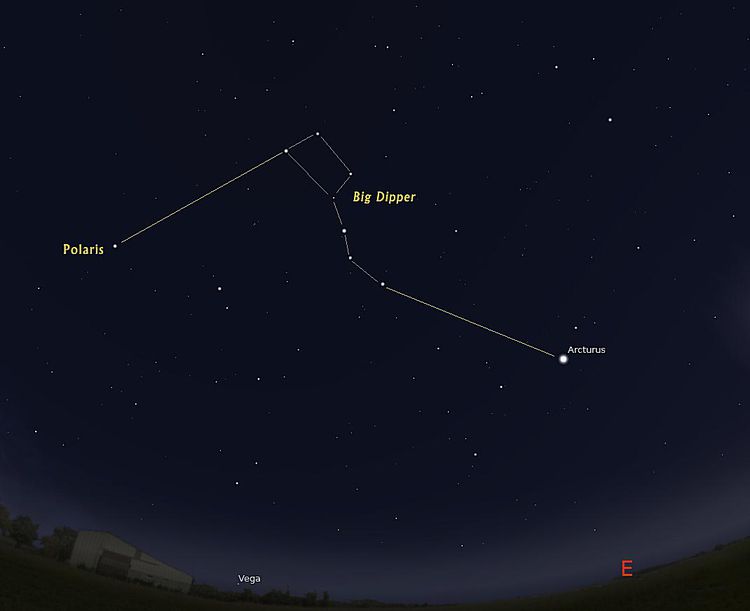
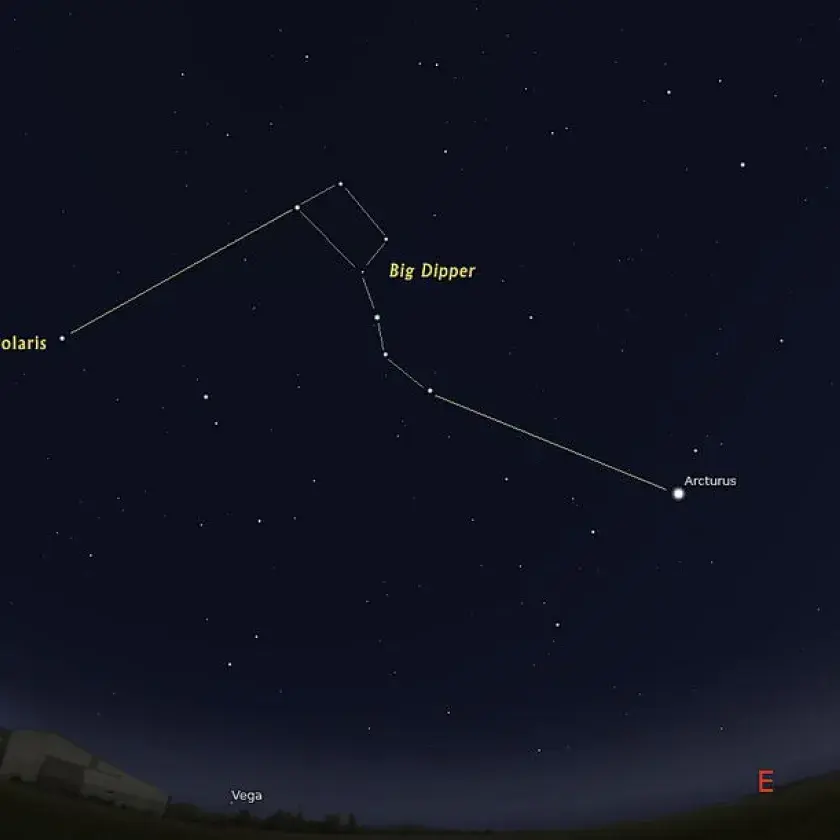
The most well-known stars in the northern part of the sky are the stars from the asterism called the Big Dipper. It is part of a constellation called Ursa Major. Four stars make up the bowl of the Big Dipper, while the three aligned stars make up the handle. The Big Dipper is visible year-round for many observers in the Northern Hemisphere.
When the Big Dipper is in view, use the two outer stars of the bowl to help draw an imaginary line to a star called the North Star, or Pole Star. It is given that distinction because the north pole of our planet appears to point directly at it. It is also called Polaris, and its formal name is Alpha Ursae Minoris (the brightest star in the constellation Ursa Minor, or the Little Bear).
Finding north
When looking at Polaris, the direction is north, which makes it a handy compass point if you are ever lost somewhere. Just remember: Polaris = north.
The handle of the Big Dipper appears to make a low arc. If an imaginary line is drawn from that arc and extended to the next brightest star, Arcturus has been found (the brightest star in the constellation Bootes). Simply “arc to Arcturus.”
When looking at the stars this month, take a closer look at Coma Berenices. It is an open cluster of about 50 stars that can probably be seen with the naked eye. Try viewing it with binoculars as well. The March star chart shows where it is.
Finding south
In the Southern Hemisphere, the North Star is largely not visible or is not always above the horizon. There, the Southern Cross (Crux) points the way to the south celestial pole.