Which season is best if you want to see the Milky Way in Denmark?

The best time to see the Milky Way is in late summer and autumn, from August to November. At that time, the Milky Way is still high in the sky in the evening.

In the spring, you have to go out early mornning, around 3 a.m., to see the Milky Way rise before the sun rises.

In the summer, the sky is so bright that it can be difficult to see the Milky Way. However, you can spot it between 1 and 2 at night.

You should choose a moonless night, when it either has not risen yet, or has set already. It's impossible to see the Milky Way when there is a lot of moonlight. You can check the rising and setting times of the Moon in our moon calendar here: https://darkskymoen.dk/en/node/108

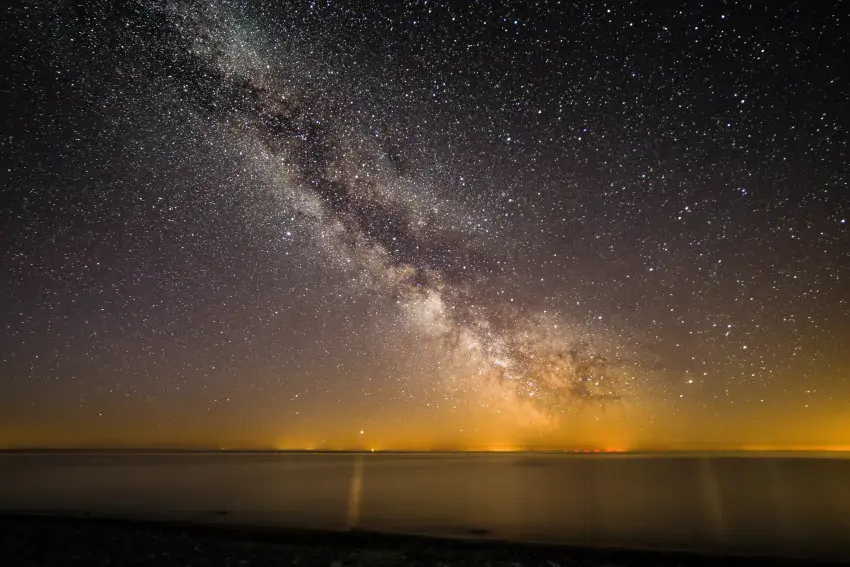
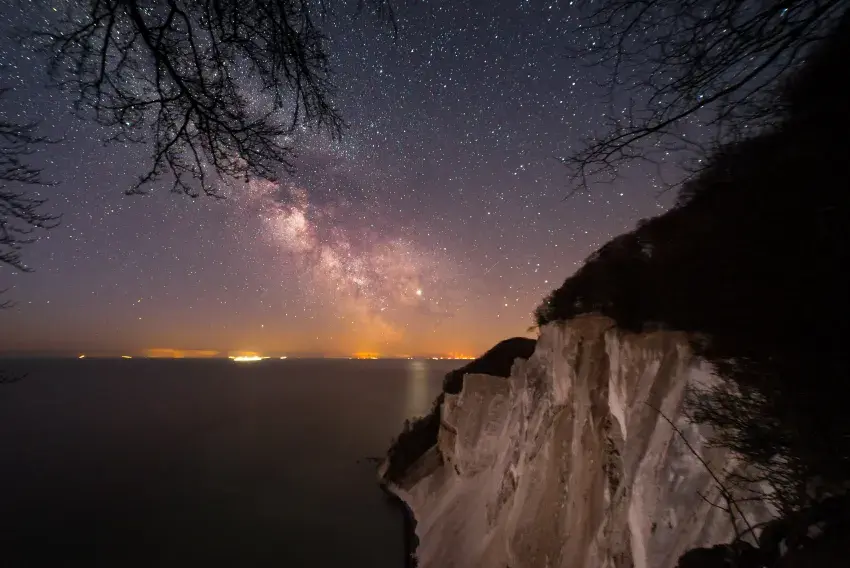
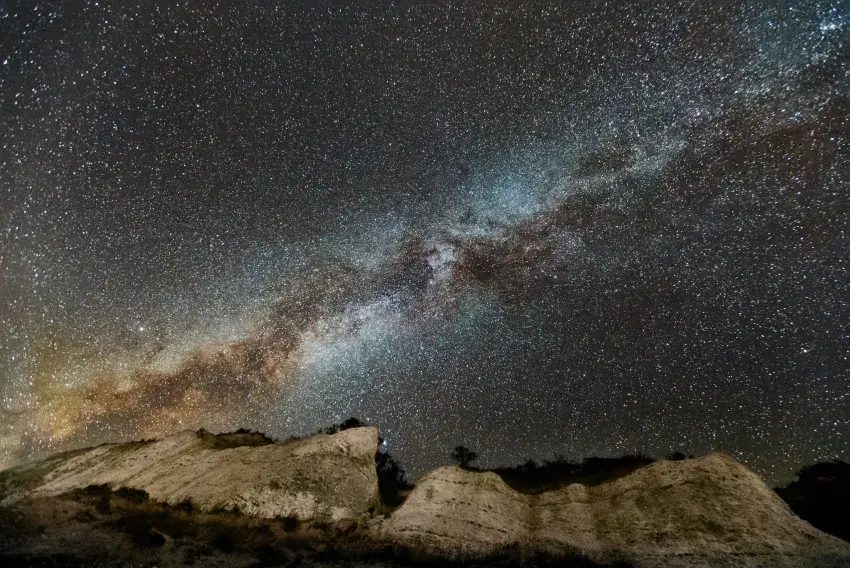
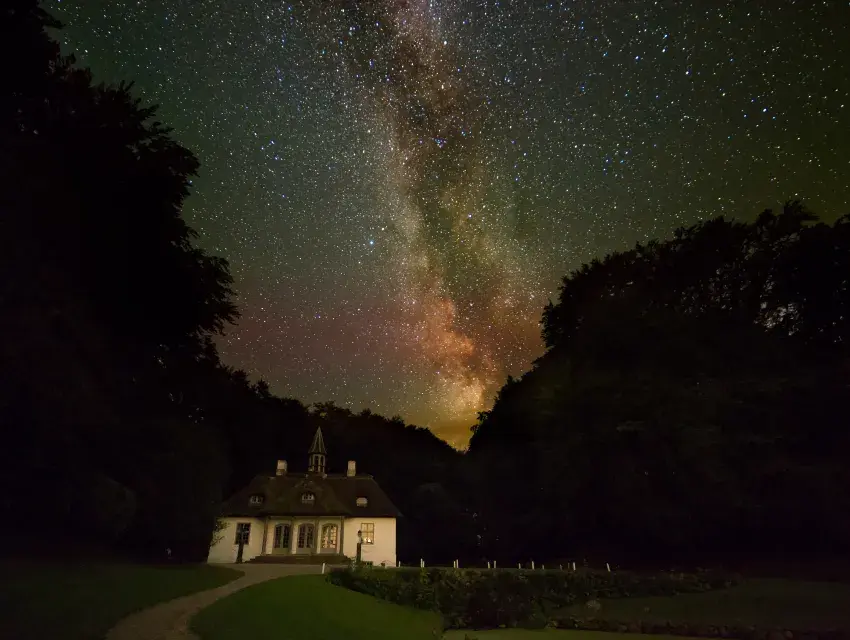
Here are some photos of the Milky Way from Dark Sky Park Møn.

Mælkevejen

Can the Milky Way be seen without binoculars or a telescope?

Yes, the Milky Way can certainly be seen with the naked eye. It requires being in a dark location and allowing time for the eyes to adjust to the darkness.

This adjustment process can last up to half an hour before the pupils are fully open. However, once the eyes have adapted to the dark, viewing at night, using only starlight, is quite possible. The Milky Way becomes very clear once located.

The Milky Way is most visible in late summer when the nights are not overly bright. During the summer, the Earth's rotation allows for a view directed toward the center of the Milky Way, but the nights are often too bright for clear viewing. However, from August to October, it is easy to find the Milky Way on a clear, moonless evening.

When there is a lot of moonlight, the Milky Way cannot be seen. The light from the Moon is stronger than the light from the Milky Way, making it invisible.

Møn is a good place to observe the Milky Way because there is less light pollution than in many other areas. Viewing the Milky Way from a city with many lights can be difficult.

Where in Denmark can you best observe the Milky Way?

On Møn and Nyord you can clearly see the Milky Way because the sky around it is so dark. 

This is because Møn is an island in Denmark with no light pollution, so you can see even the faintest things in the sky. 

For example, the Andromeda Galaxy can be seen with the naked eye from Møn.

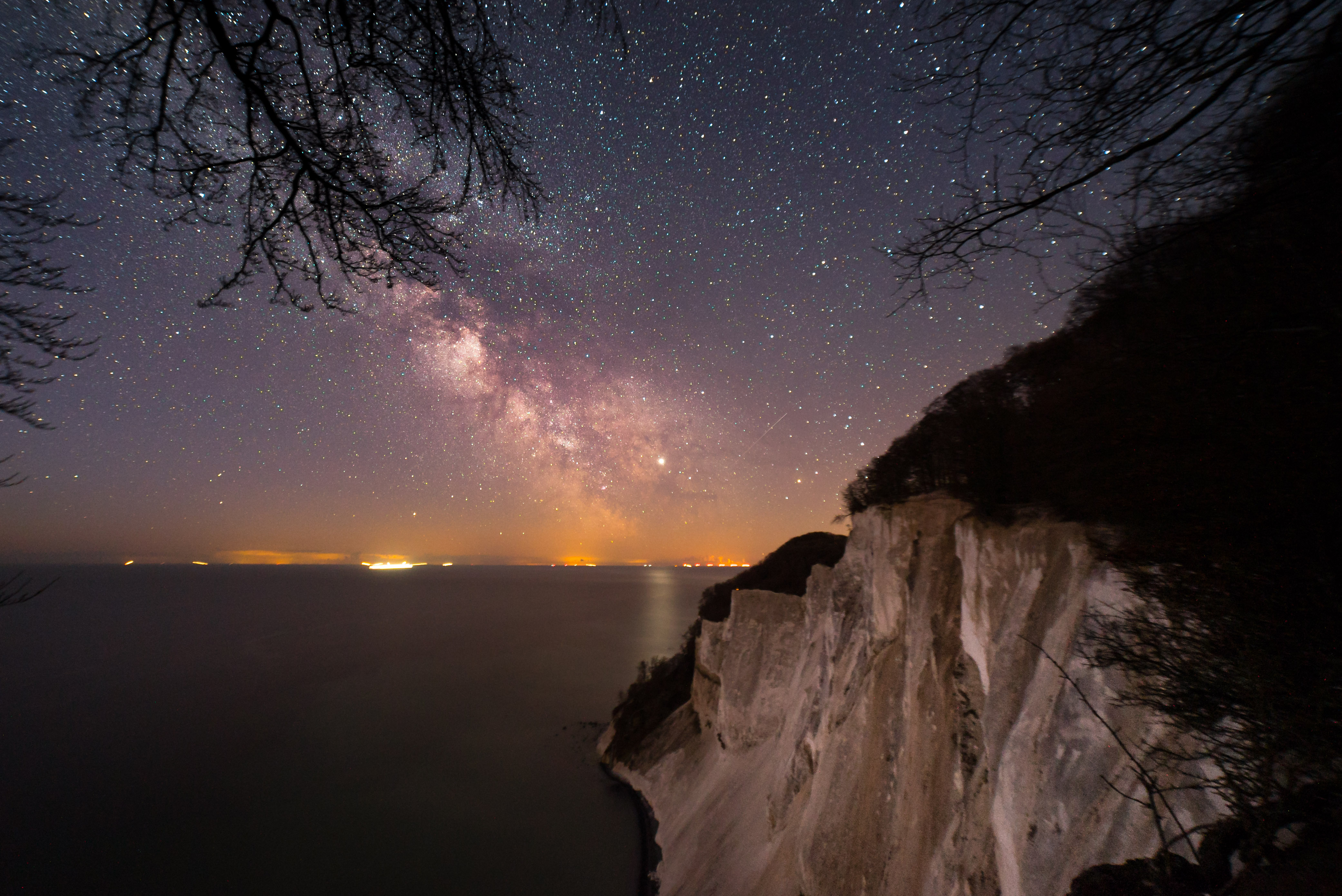
The Milky Way from the top of Møns Klint
Milky Way at Møns Klint

What is the best way to start looking at stars and other things in the sky?

The best way to start looking at the night sky is to put on nice warm clothes, go to a dark place with a sleeping pad, and then lie down comfortably and look up at the sky. If you have good binoculars, you can try using them.

The best binoculars to use are low magnification wide angle binoculars, they are available with 2x magnification at around 40mm. lenses. 

If you are looking for shooting stars, you don't have to use binoculars, just your eyes. You can read more about watching meteors here: https://darkskymoen.dk/en/node/160

It is important to give the eyes time to get used to the dark. If you just have looked into a phone, or come straight from a lighted place, it takes up to half an hour for your eyes to get used to the darkness again.

If you must use a lamp, you must not use one with white light. Red light is better for preserving night vision. If you don't have a special red light, a bicycle rear light is just as good.

You can read much more about seeing and enjoying the night sky here: https://darkskymoen.dk/en/node/228


When is the best time of year to look for meteors?

We have made a list of the largest meteor showers, including the approximate dates they are visible. You can use that list to find the best times to plan a meteor hunt.

Meteors can be seen all year round, on any clear moonless night. Especially if you are in a very dark area, such as Møn. Just find a nice dark spot, lie down on a mat, relax, and look at the sky. It's important not to stare at a specific area, because meteors can appear anywhere.

The longest lasting meteors appear in the evening. There are more meteors in the morning before sunrise, but they are shorter-lived.

Read more about meteor-watching here: https://darkskymoen.dk/en/node/160


What is the best way to photograph the night sky, the stars and the Milky Way?

You need a camera that can be set manually, both aperture, shutter speed and focus. You also need to use a tripod or something the camera can rest securely on.

To photograph large objects, such as landscapes or the Milky Way, you need a wide-angle lens, e.g. 14 mm.

We go much more in depth about photography at night in this article: https://darkskymoen.dk/en/node/222

How do you know that Møn is a Dark Sky place?

The entire Dark Sky Park part of Møn and Nyord has a fantastic night sky.

This is because Møn is an island in Denmark with no light pollution.

The unit called 'MPSAS" (mag/arcsec2) is used to indicate how dark the sky is. The higher the number, the darker the sky. When the unit increases by 1, it means that the amount of light pollution is doubled. And every time the amount of light pollution is doubled, the number of visible stars is halved.

In clear weather without moonlight, the sky above Møn has a value of around 21.8.
On the Bortle scale, it corresponds to between 1 and 2, i.e. the best class available.

It must be seen in relation to e.g. Copenhagen, where MPSAS is around 18. This is 8 times more light pollution than Møn. In Køge the number is 20, i.e. 4 times as much light as on Møn.

We constantly measure how dark it is on Møn. The results can be seen here.

The measurements show that Møn is extremely dark at night. We are doing our best to preserve the darkness, by trying to convince people to use less outdoor lighting, and limit light pollution from businesses.

There is an association called Dark Sky Denmark, working to prevent the increasing light pollution, by teachinng children and others about light pollution and its bad effects on people and wildlife. 

When is the best season or date to visit Dark Sky Park Møn?

Dark Sky Park Møn & Nyord is worth a visit all year round.

Different parts of the sky can be seen at different seasons, as we look out in different directions at night as we orbit the sun during the year. So if you want to see something specific, it is important to know which season is best for it. If there is something special you want to see, we will be happy to answer when it is best.

The experience is of course different depending on the time of year, here is a short summary:

Winter (November - February): Most dark hours, the Milky Way is less visible, the winter constellations such as Orion is only visible now. It is typically quite cloudy in winter, but there may well be some periods of clear weather.

Spring (March - May): The Milky Way is more visible, animals are very active, skies are often clear and humidity is lower.

Summer (June - July): The Milky Way is right above us, luminous night clouds are nice to see, but there are not many dark hours. From midnight to 2 is the darkest, then the sky can be very beautiful with a constant sunset to the north, where the sun hides just below the horizon.

Late summer (August - October): Best time to see the Milky Way. In these years (2023-2025) it is also the best time to see the big, beautiful planets Saturn and Jupiter. 

The major planets are visible at different times of the year, it changes every year. Here is an overview of the planets: https://darkskymoen.dk/en/node/227

It is best to see the night sky when there is no moonlight. See our moon calendar to find the best nights when the moon has not risen yet: https://darkskymoen.dk/en/node/108

Where is the best location in Denmark to see many stars at night?

On Møn and Nyord you can see many more stars than anywhere else in Denmark. 

This is because there is less light pollution, so you can see even the smallest stars. 

Where in a big city you can see around 100 stars in the sky, on Møn you can see more than 5000 stars. 

You can also see many more shooting stars (meteors) because the sky is dark.

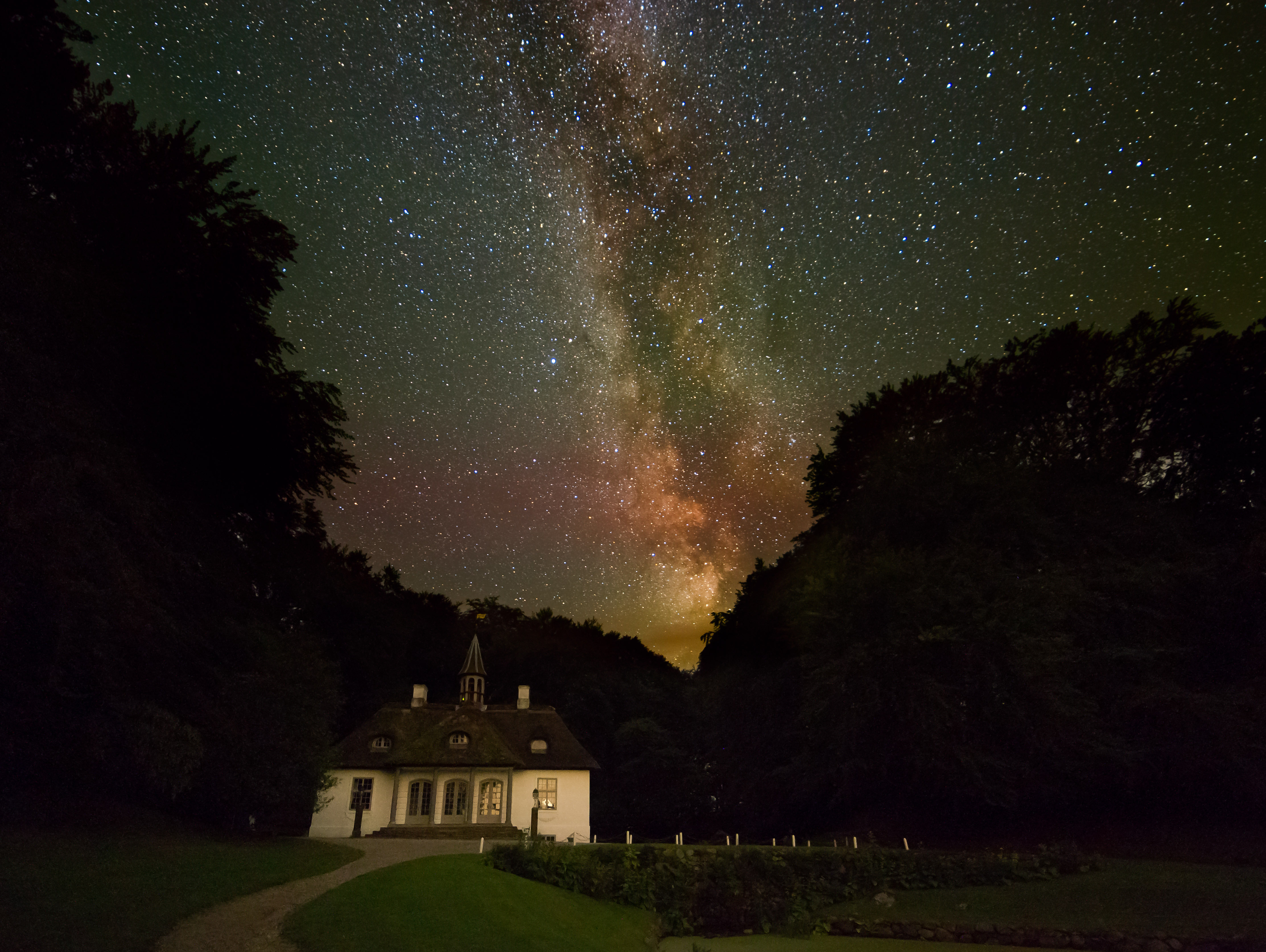
Liselund Slot

Where in Denmark can we find the darkest skies?

Møn and Nyord is the only place in Denmark officially designated as a Dark Sky Park, which means that the darkness of the night is protected from light pollution. The night sky darkness is continuously monitored, and the level of darkness can be seen live at https://darkskymoen.dk/en/posts/real-time-sqm-measurements-mon

But several other areas are on their way to achieving the same status.

An association, Dark Sky Denmark, has started a campaign and project to investigate what can be done against the increasing light pollution in Denmark, i.a. by measurements and knowledge sharing.

When can you best see Orions belt in Denmark?

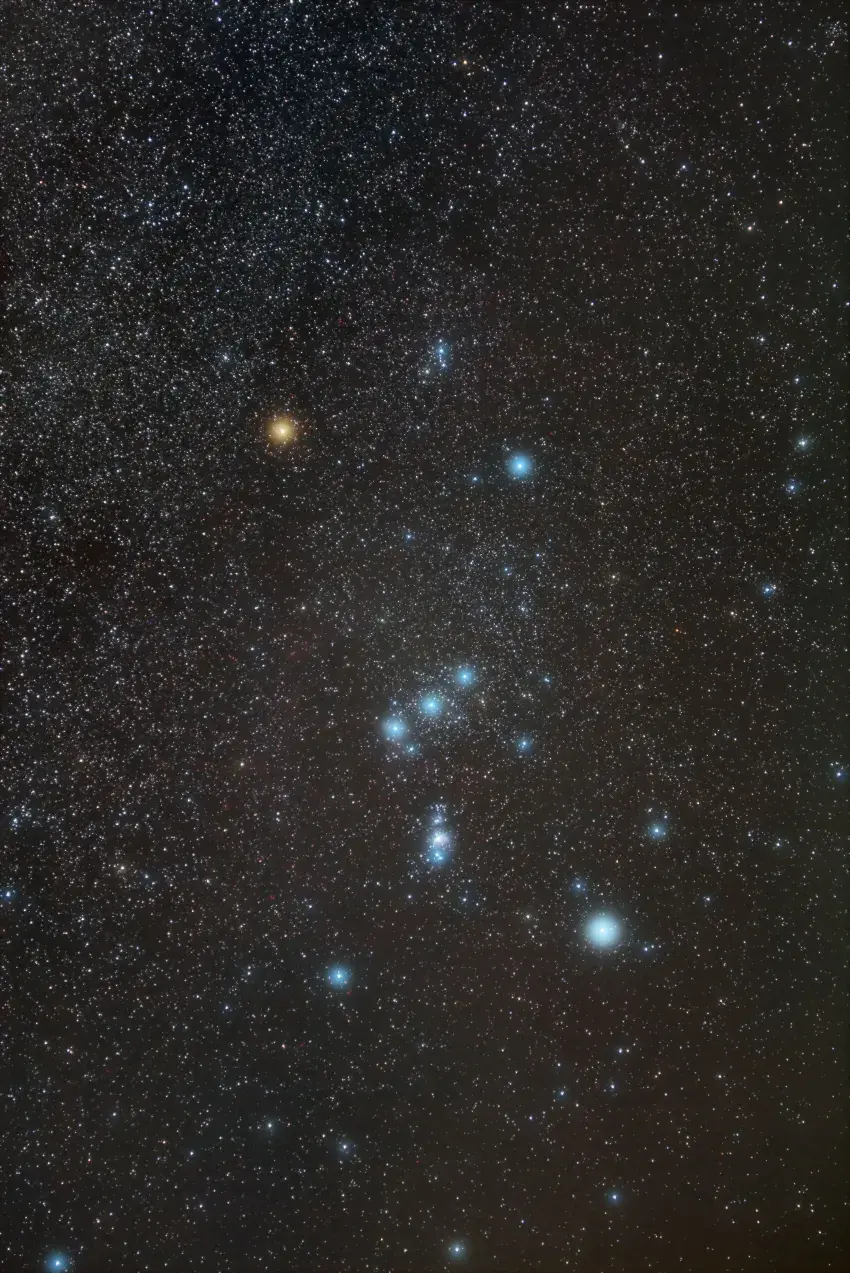
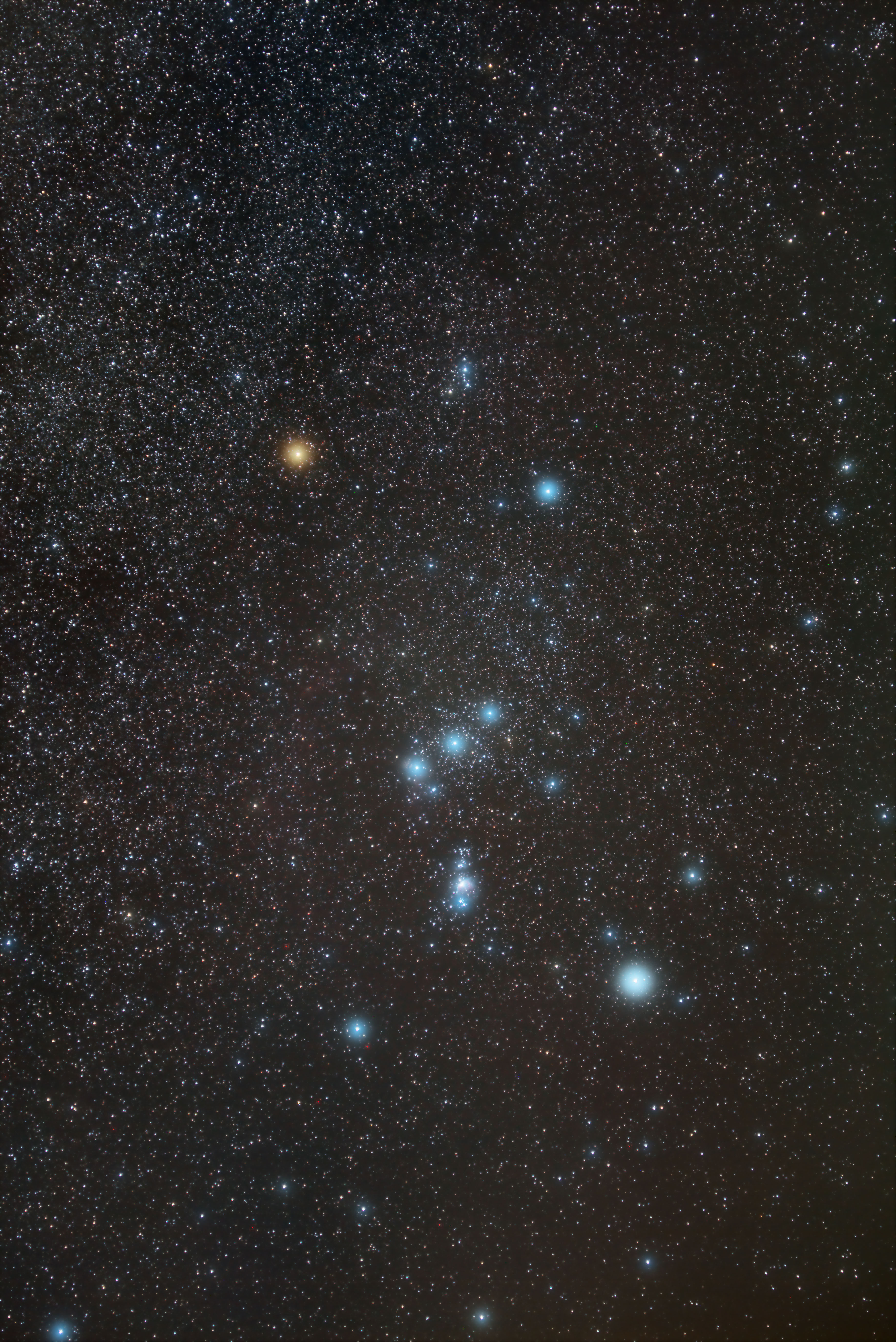
Orion is one of the most beautiful constellations in the night sky. The constellation is only visible in Denmark in autumn and winter.

Orion begins to be visible from the beginning of October, when the constellation rises at midnight, and is fully visible at 2.

For the next few months, Orion can be seen all night until March when it sets around 23.

What is the name of the brightest star in the night sky?

Sirius (or Alpha Canis Majoris) is the brightest star in the sky and the main star in the constellation "The Big Dog". For that reason it is also known as the Dog Star.

In the evening, when the sun has just set, you can often see Sirius flashing in many colors. This is because the atmosphere is still cooling and the air is therefore unstable. It's not because the star is twinkling.

Will there eventually be more light pollution? Does it matter if we turn on one more lamp when there is already a lot of light in the area?

Yes, the amount of light pollution increases by around 8% annually in Denmark. Worldwide, light pollution increases by around 10%. 

The increasing light pollution means that we will soon not be able to see a dark sky anywhere. 

Light pollution spreads without boundaries, so places that try to limit light pollution will end up having their night skies destroyed by light pollution from other areas. 

Every lamp counts

The total amount of light that spreads into the sky increases every time a new lamp is switched on. 

You often hear the excuse that there are so many other lamps, so it makes no difference if there is one more or less. 

But that is wrong. Every new lamp increases light pollution, and every lamp that is switched off will reduce light pollution to the surroundings.

What are the most exciting experiences in South Zealand & Møn?

South Zealand & Møn features a diverse mix of nature, culture, and activity, making it suitable for various types of travelers. The region offers everything from dramatic coastal cliffs and ancient manors to quiet forests and vibrant local markets.

The natural scenery is a major draw, featuring everything from rolling fields and beech forests to iconic chalk cliffs, particularly those found on Møn. These diverse landscapes support multiple forms of exploration, including hiking, cycling, and general nature walks.

A unique highlight is the exceptional dark sky quality on Møn, providing world-class stargazing opportunities that are perfect for reflection and amateur astronomy. The region's commitment to preserving low light pollution significantly enhances the tourist experience.

Beyond natural wonders, the area boasts rich cultural elements. Historic towns, preserved manors, and museums give context to the journey, blending local history with the environment. The convenience of combining these activities—such as exploring a town, visiting an estate, and spending the night beneath the stars—is a core strength.

Travel options are extensive, accommodating nearly every interest: the coast offers great spots for swimming and viewing; kayaking and sailing bring the sea to life; and trails cater to varied fitness levels. Furthermore, the local food culture, based on fresh, seasonal ingredients and maritime specialties, enhances the travel experience. The combination of active adventure, historical depth, and deep natural beauty makes the region highly appealing for both slow, relaxed travel and fast-paced exploration.

Why do some stars burn for much longer than others?

Stars burn at different rates due to variations in their mass, composition, and stage of stellar evolution.

Mass is the Primary Determinant

The single most influential factor determining a star's lifespan and energy consumption rate is its initial mass.

  • Higher Mass Means Higher Energy Output: More massive stars contain significantly more gravitational potential energy and undergo more vigorous core fusion. The immense pressure and temperature in their cores force fusion reactions (the process converting hydrogen to helium) to occur at a much higher rate.
  • Increased Luminosity and Heat: This accelerated fusion leads to extreme luminosity. The energy output is immense, resulting in a much higher radiant heat flow and, consequently, a rapid consumption of fuel.
  • Short Lifespan: Because the rate of fuel consumption is so high, massive stars exhaust their hydrogen fuel in a matter of millions of years, leading to spectacular, but comparatively brief, lives.
  • Lower Mass Means Slower Rate: Less massive stars, such as red dwarfs, have weaker gravitational forces, leading to lower core temperatures and pressures. This results in slower, more efficient fusion processes and an extremely slow energy release rate.
  • Long Lifespan: This slow burn allows low-mass stars to consume their fuel over timescales that can exceed the age of the universe.

Core Composition and Fusion Efficiency

The type of fusion occurring within the stellar core also dictates the rate.

  • Stable Burning: During the main sequence phase, the star is in a state of equilibrium where the outward pressure generated by fusion balances the inward pull of gravity. The fuel available (hydrogen) determines the operating rate.
  • Fuel Exhaustion and Changes: As the star depletes its primary fuel (hydrogen), subsequent fusion stages begin (e.g., helium burning, carbon burning). Each stage involves different temperatures and pressures, and the rate of energy release changes dramatically as the core contracts and heats up for the next phase.

Stellar Structure and Brightness

The stellar structure itself acts as a measure of the burning rate.

  • Luminosity and Mass Relationship: For stars on the main sequence, luminosity (the total energy radiated) is strongly correlated with mass. A higher luminosity implies a greater rate of energy generation and consumption.
  • Evolutionary Stages: Stars do not maintain a steady burn rate throughout their entire lives. Following the main sequence, a star begins to expand and change its internal structure, which means the rate of energy production and its resultant luminosity change radically.

Table of Different types of Stars, and Burn Rates

Star Type

Mass Range

Core Pressure/Temperature

Energy Output Rate

Relative Lifespan

Massive Stars (O, B class)

High (e.g., > 8 times Solar Mass)

Extremely High

Very High

Short (Millions of Years)

Sun-like Stars (G class)

Medium (1 to 8 Solar Masses)

Medium

Moderate

Long (Billions of Years)

Low-Mass Stars (M class/Red Dwarfs)

Low (e.g., < 0.5 Solar Mass)

Low

Very Low

Extremely Long (Trillions of Years)

Orion

Where can one experience a beautiful undisturbed night sky in Denmark?

Dark Sky Park Møn og Nyord was the first Dark Sky Park in Denmark.

More Dark Sky Parks are on the way, in Langeland, Mandø and Anholt, and in the village of Taarup on Funen. 

A Dark Sky Park is an area with a unique quality of star-clear nights and a nocturnal environment that is specifically protected for its scientific, natural or educational value, its cultural heritage and/or public enjoyment.

The most important purpose of a Dark Sky Park is not to entertain people. Although seeing many stars, the Milky Way, and other wonderful things in the night sky is a great experience, the effect on ecosystems and biodiversity is much more important than that.

The Dark Sky Denmark association works to expand the concept, from small isolated Dark Sky Parks, to cover much larger areas. It is a long process, which consists of several steps:

  • Identification of sources of light pollution
  • Businesses and residents are encouraged to minimize their light pollution, even if they are located in a heavily light-polluted area
  • Reward of businesses and residents who improve their use of lighting at night, and have proven a reduction of their light pollution

There are no barriers that stop the spread of light pollution, so every source of light pollution affects a large area. 

There are no laws that limit light pollution.

Even a small improvement is a step in the right direction toward the goal of stopping the constant increase of light pollution in Denmark.

What is the Milky Way, and how large is it?

The Milky Way is a barred spiral galaxy. It is the galaxy that contains the solar system and the sun. It is not a single object but a massive system of stars, stellar remnants, gas, and dust, all gravitationally bound.

Size and Scale

In terms of physical span, estimates suggest the Milky Way has a diameter of approximately 100,000 to 200,000 years of light-years. The thickness of the galactic disk is much smaller, estimated to be only a few thousand light-years.

The galactic structure is composed of several arms rotating around a central bulge. The solar system resides in one of these arms, known as the Orion Arm.

Stellar Population

The Milky Way contains an extremely large number of stars. Estimates for the total number of stars within the galaxy range from 100 to 400 billion stars. This estimate accounts for the visible stars as well as dimmer, uncounted stellar populations.

What is a black hole, and how do they work?

What Is a Black Hole?

A black hole is a region of spacetime where gravity is so strong that nothing, including light and other electromagnetic waves, can escape from it. The boundary defining the point of no return is called the event horizon. This powerful gravitational pull is the defining characteristic of a black hole.

Because black holes trap light, they appear perfectly black, giving them their name. The immense concentration of mass into an extremely small space results in the extreme curvature of spacetime.

How Are Black Holes Created?

The primary mechanism for black hole formation involves the life cycle and death of extremely massive stars.

Stellar Collapse
  1. Massive Stars: The process begins with a star significantly more massive than the Sun (typically having at least 20 to 25 times the Sun's mass). These stars sustain themselves through thermonuclear fusion in their core, converting hydrogen into helium, and subsequently fusing heavier elements into even heavier ones (up to iron).
  2. Fusion Ends: Fusion provides the outward pressure that balances the star's inward force of gravity. When the star depletes its fuel, fusion ceases. In the case of iron, fusion no longer releases energy; instead, it consumes energy, leading to an immediate pressure deficit.
  3. Gravitational Collapse: Without the outward support from fusion, the star's core experiences catastrophic gravitational collapse. The immense force of its own gravity crushes the stellar material inward.
  4. Formation: If the core's remaining mass exceeds the Tolman–Oppenheimer–Volkoff limit (approximately three times the mass of the Sun), no known force, including neutron degeneracy pressure, can withstand the crushing gravity. The core collapses past the point of no return, forming a singularity—the core of the black hole.

(Note: Other theoretical mechanisms, such as the collapse of massive galaxies or remnants from cosmic string interactions, exist but stellar collapse remains the most widely accepted model.)

How Do Black Holes Work?

The physics operating within and around a black hole are governed by extreme gravitational forces and the principles of General Relativity.

Key Components and Concepts

1. Singularity

The singularity is the center of the black hole. It is the point in spacetime where the majority of the star's mass has collapsed. Physicists predict that at the singularity, density and gravitational curvature become infinite, and the known laws of physics break down. The singularity itself is not a "thing" but rather a representation of infinite spacetime curvature.

2. Event Horizon

The event horizon is the boundary surrounding the singularity. It acts as the spherical limit of escape. Once matter or light crosses this boundary, the gravitational pull is so strong that the required escape velocity exceeds the speed of light. Since nothing can travel faster than light, escape is impossible.

3. Spaghettification

This process describes the intense tidal forces near a black hole. As an object approaches the event horizon, the gravitational pull on the parts of the object closer to the singularity is vastly stronger than the pull on the parts farther away. This differential force literally stretches the object vertically and compresses it horizontally, resembling a piece of spaghetti.

Interaction with Matter (Accretion Disks)

While black holes themselves are invisible, their action is observed through the matter orbiting them:

  • Accretion Disk: Gas, dust, and stellar material are pulled by the black hole's gravity and form a swirling disk of superheated plasma around it.
  • Energy Emission: The intense friction and compression within the accretion disk heat the plasma to millions of degrees Celsius. This superheated material emits tremendous amounts of energy, primarily in the form of X-rays and gamma rays, allowing astronomers to detect the black hole's presence even if it is not emitting visible light itself.

What are stars, and how far away are they?

How far away are stars?

Stars are incredibly far away, measured in light-years. A light-year is the distance that light travels in one Earth year. Since light travels at a finite speed, the time it takes for starlight to reach Earth allows astronomers to view the past state of a star.

What is astronomy?

Astronomy is the scientific study of celestial objects, space, and the physical universe as a whole. It encompasses the study of planets, stars, galaxies, comets, and other astronomical features.

What is the difference between a planet and a star?

  • Stars: Stars are massive celestial bodies that generate their own light and energy through nuclear fusion in their cores (typically fusing hydrogen into helium).
  • Planets: Planets are celestial bodies that orbit a star and have cleared their surrounding orbital paths. They do not generate their own light and are visible because they reflect the light of their parent star.

What are galaxies?

A galaxy is a massive, gravitationally bound system consisting of stars, stellar remnants, interstellar gas, dust, and total amounts of dark matter. Our galaxy is called the Milky Way.

How old is the universe?

The prevailing scientific consensus, based on measurements of the cosmic microwave background radiation and the expansion rate of the universe, suggests that the universe is approximately 13.8 billion years old.

What is a black hole?

A black hole is a region of spacetime where gravity is so strong that nothing, not even light, can escape. They typically form from the gravitational collapse of massive stars.

What is cosmic background radiation?

Cosmic microwave background (CMB) radiation is faint electromagnetic radiation that fills the entire observable universe. It is considered the "afterglow" of the Big Bang and provides critical evidence for the theory of the universe's origin.

Are there exoplanets?

Yes. An exoplanet is a planet that orbits a star outside the solar system. The discovery of exoplanets has vastly expanded the scope of the search for life beyond Earth.